




I spent 24 hours in an ice cave watching my thoughts. That’s where I saw the pattern.
A Loop is approximately 20 minutes of “watch out for the wolves at the gate” internal thoughts—a driven manifesto. The loop represents thoughts on repeat, like a record player. The same anxieties, the same fears—it would restart about once an hour, the same 20 minutes, like clockwork.
After the ninth or tenth cycle, something clicked. These thoughts weren’t telling me the truth. They were just running a program. And once I saw the loop, it lost its power.
That realization changed how I run my business, coach my sales teams, and make decisions under pressure. But here’s what surprised me: the neuroscience backs this up.
Self-awareness isn’t philosophical. It’s measurable brain activity.
The Anterior Prefrontal Cortex: Where Noticing Happens
When you reflect on your thoughts, a specific region lights up: the anterior prefrontal cortex (aPFC).
This area distinguishes human metacognition from animal cognition. It’s the neural hardware that lets you think about your thinking. Research from the Journal of Neuroscience shows that activity in the right rostrolateral prefrontal cortex correlates with metacognitive ability across individuals.
Translation: awareness is a brain function you can train.
When you do daily habit tracking or MEPS check-ins (Mental, Emotional, Physical, Spiritual), you’re deliberately activating this region. You’re not journaling for therapy. You’re doing a neural workout.
UCLA Research: Why Naming Your Feelings Calms Your Brain
Here’s the mechanism behind why reflection on your thought works.
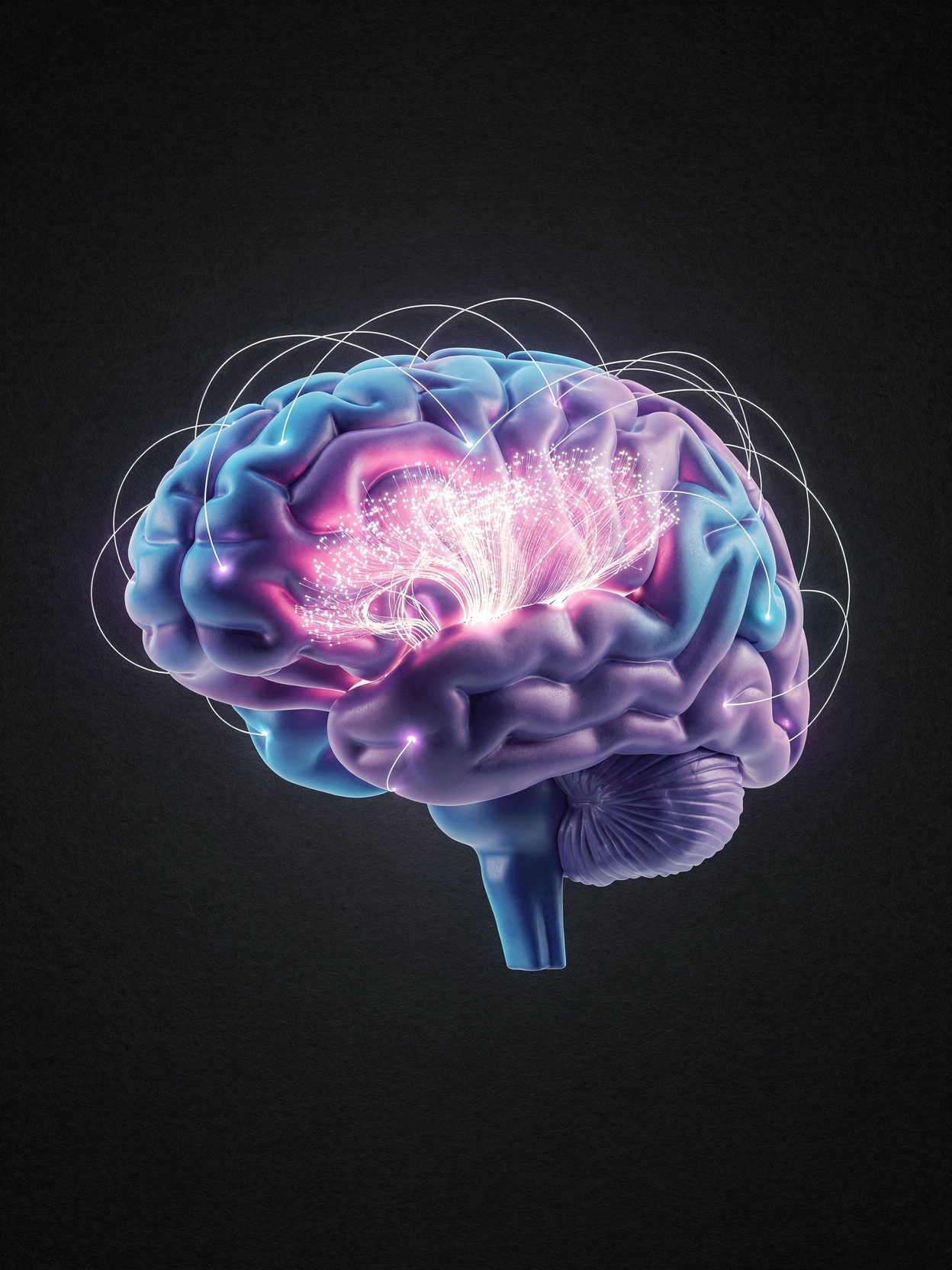
UCLA researchers discovered that when you label an emotion, your right ventrolateral prefrontal cortex (RVLPFC) activates and your amygdala—the brain’s fear center—quiets down.
Putting feelings into words is like hitting the brakes on your emotional response.
I see this play out with sales reps constantly. Weather someone’s panicking about a deal falling through or thinking about a fight they had at home, once a bad thought starts, they spiral. They make fewer calls. They give up on objections too easily. They let prospects blow them off because they expect to get blown off.
But when they learn to name what they’re feeling, like “I’m anxious this won’t close” or “I’m frustrated with this objection,” the panic loses its grip.
MEPS check-ins operationalize this finding. It’s a zero-cost daily intervention backed by neuroscience.
Memory Reconsolidation: Your Identity is Fluid
Here’s something most people don’t realize: every time you recall a memory, you can rewrite it.
Research on memory reconsolidation shows that retrieved memories enter a plastic state. During this window, the memory can be disrupted, strengthened, or modified.
Nader, Schafe, and Le Doux demonstrated this in their landmark 2000 study. Long-term memories aren’t fixed. They update every time you activate them.
This is what I discovered in that ice cave. The anxiety loop wasn’t truth. It was a pattern I’d reinforced by engaging with it , it was constant and fear based interrupted by daily life and running in circles to keep me safe but once I notice it, once I start to see it without reacting, I weakened the neural pathway.
Meditation creates the safe conditions for this rewiring to occur.
When you sit with a thought loop and simply observe it, you’re not suppressing or pushing it away. Instead, you’re initiating the process of reconsolidating the memory without its accompanying emotional charge. You need to first witness the thought pattern and recognize it for precisely what it is: FEAR.

Learning to Pause Between Stimulus and Response
Metacognition enhances behavioral flexibility by creating a deliberate space between external events and your subsequent reactions.
The dorsal anterior cingulate cortex (dACC) continuously monitors decision-making uncertainty, while the lateral frontopolar cortex (lFPC) manages metacognitive control processes. Together, these neural structures form an integrated closed-loop system that enables adaptive responses without requiring conscious effort or forcing.
Subsequently, drawing upon my transformative experience in the ice cave, I developed awareness of my anxiety as it manifested through recognizable patterns, which allowed me to identify and distinguish between different emotional states I inhabited.
What Emotional and Mental Regulation Looks Like in Sales
I had a rep named Pat. She sold a B2B SaaS product for us. Great rep, but she was in a bad mood most days.
Her numbers reflected it. She made fewer calls than she logged. She felt like she talked to more people than she did. She got curt with customers or gave up too easily on objections.
Here’s what changed: I brought in an Oculus and had her do a guided meditation using an immersive meditation app. Then we taught her the release meditation —a one-word mantra you repeat to transition between mental states. We added daily MEPS check-ins.
Six months later, Pat was in-charge and running “positive headspace” for the sales floor. Her revenue numbers reflected the shift.
The behavior that changed? She stopped letting negative emotion control her. When you’re present in the moment, you follow your training. When you’re in your head, you skip steps.
We teach a five-step sales process: introduction, short story, presentation, close, rehash. When a rep’s in a bad mood, they miss one or two steps on every call. Once they get centered and review their calls with training materials beside them, they see it immediately.
But if you’re emotional when you listen to your calls, you just get focused on what’s going wrong .
It’s hard to reflect when you’re emotional. You get your emotions under control by getting your thought patterns under control.

Why Business Owners Need This
Most founders and sales leaders are allergic to sitting still. They equate reflection with wasting time, equate taking time to plan, dream and strategize as “lack of work”
I get it. When you’re scaling a company, efficiency matters as much as time. You add teams and systems to move faster. You delegate. You stop expecting perfection.
But here’s what I learned: noticing how you’re feeling and where you’re at, drastically changes how effective you can be.
Something as simple as not deciding what to wear each morning—I picked that up from a Zuckerberg interview—saves decision bandwidth. You only have so many decisions in a day.
When I became aware of those decision fatigue and what zone I was in, my productivity shifted. When I set myself up for deep work or noticed I was ready, I was 100 times more effective.
When the focus disappeared, I didn’t force it. I came back to it later.
The Self Development System That Makes This Sustainable
There are a lot of gurus under 30 who seem to know everything about building your business. That’s not who I recommend.
You want Brendon Burchard and the Growth Day team. They’ve been running the High Performance Institute since the 90s, studying this for 25 years. They give you real systems, processes, and habits that work.
Growth Day provides the structure: though they don’t have MEPS check-ins, they have habit tracking, guided reflection. Science needs a system to become sustainable.
If you’re a business owner or salesperson, this applies to you. You need self-reflection. Growth Day is a solid place to start.
Pair it with Eckhart Tolle’s The Power of Now That book bridges contemplative wisdom and modern neuroscience. It shows that noticing isn’t passive. It’s the active ingredient of growth.

What I’d Tell My Younger Self
If I could go back and talk to the Tyler who was jumping between offices, making 100 decisions a day, grinding through exhaustion, here’s what I’d say:
Notice when you’re stressed and overwhelmed. Take breaks. Get present. Transition.
Your stress is a sign you need to spend time with your niece and nephew. Go see your family. Go snowboarding or rock climbing. Get out in the woods. Put work down and come back to it.
You’ll be way more productive when you’re focused and prepped.
Yes, you need to grind. You always have. You always will. If you want to make millions, you’re going to grind.
But what if you could do in four hours—in your best mental state—what would take you eight hours in your current mental state?
Don’t forget to take care of yourself. That includes your mental, emotional, physical, and spiritual health.
You’ll show up better. You’ll do better. You’ll make better decisions. Your company will thank you for it.
And if you’re a sales rep, your paycheck will thank you for it.

Try This
Start with a 7-day free trial of Growth Day. Do the daily MEPS check-in. Try the release meditation when you’re transitioning between roles—CEO to coach, founder to parent.
Pick up The Power of Now. Read the first chapter.
Then notice. Don’t force. Just notice.
Your brain will do the rest.
Want to Think, Decide, and Perform Better Under Pressure?
Most leaders try to force clarity. The ones who scale learn to notice first.
If you’re curious how this kind of awareness translates into better decisions, stronger leadership, and more consistent performance in your business, let’s talk it through.
👉 Book a short strategy call with Tyler to explore what’s possible and what’s a waste of time.
Or learn more at ATP Sales & Marketing